Lead School
Designing the B2B Engine of an EdTech Unicorn
Executive Summary
The Mission: Design the B2B analytics and performance platform that convinced school owners to buy into the LEAD ecosystem — while simultaneously leading UX research across an entire multi-product design organization.
"Turning a data-heavy ERP system into a decision-support tool that made school owners confident, principals effective, and coordinators self-sufficient — without a single support call."
The Challenge: Own end-to-end design for a complex B2B ERP platform serving multiple stakeholder roles, lead research across 7 designers and 4 products simultaneously, and build an AI recommendation engine two years before AI became a product expectation.
The Role: Solo Product Designer on the B2B ERP system. De facto Research Lead across the full design organization. Design mentor to junior designers. Trusted with the highest-stakes rapid prototype when the team needed it most.
Business Impact: 70% reduction in support tickets through Yiso AI. 96% task completion time reduction — from 3-4 hours to 10 minutes. 22% improvement in educator retention — highest ever recorded at the company. 35% reduction in average task completion time. Best Group Award for OAC POC delivery. Product shipped and running live in thousands of schools across India today.
One Designer. One ERP. One Unicorn.
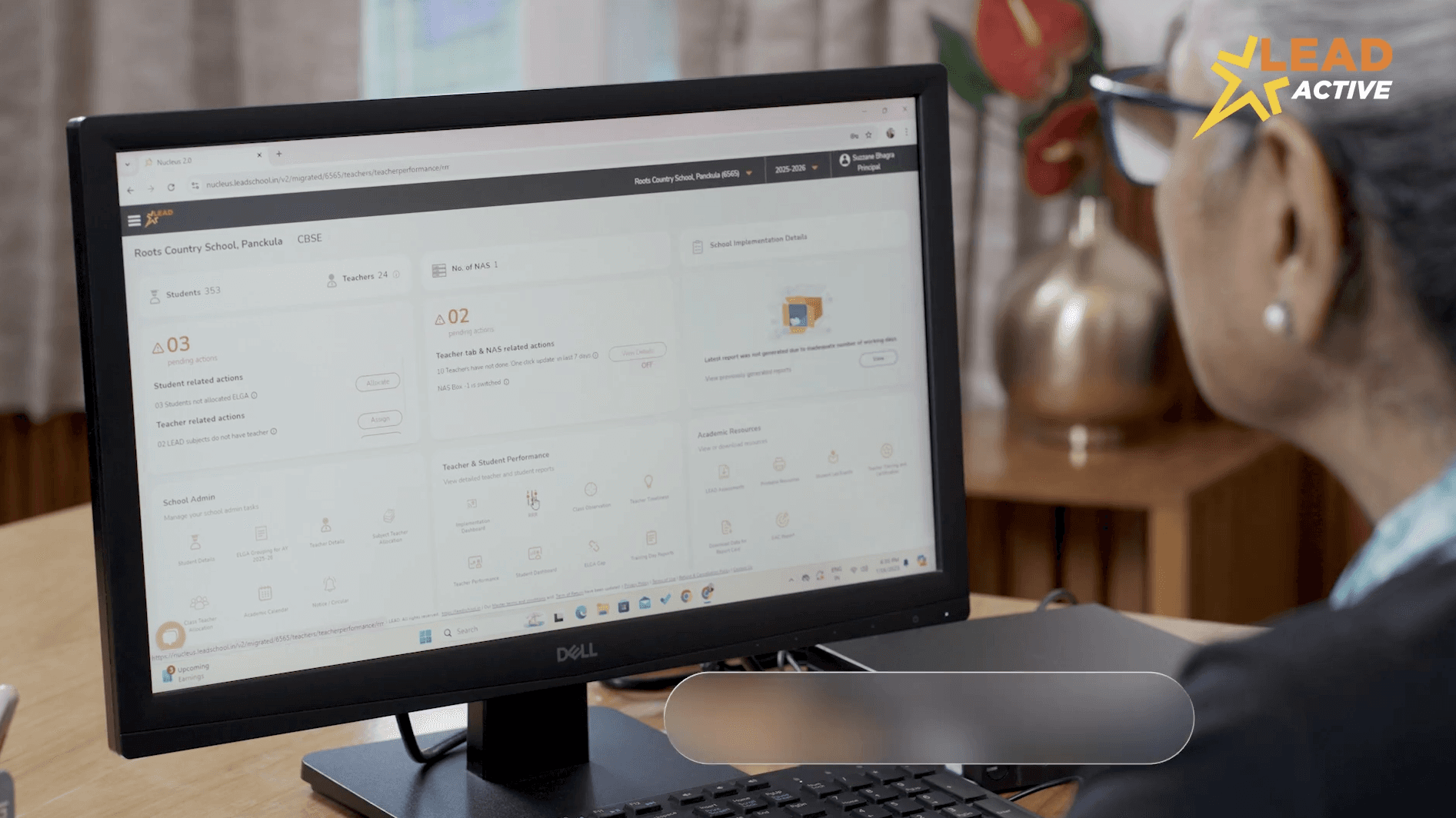
I was the solo designer on Nucleus — LEAD's B2B ERP system and the academic management platform that school owners, principals, and coordinators used to run their entire school. Attendance patterns. Academic performance. Teacher effectiveness. ELGA allocation. Subject mapping. Operational health. All of it, in one interface, designed to make non-technical school administrators feel confident and in control.
This wasn't a consumer product where users could tolerate friction. This was a B2B platform where confusion at the interface level translated directly into lost school partnerships. If a principal couldn't understand their dashboard, LEAD lost a school. The stakes were that direct and that high.
And I owned it alone.
What I didn't own alone was research. Because across the full design organization — 7 designers, 4 products, B2B and B2C — I became the person everyone relied on for research methodology, heuristic evaluation, and usability testing. Not because I was assigned to it. Because I was the most experienced and I understood that good design across any product starts with the same foundation — understanding how people actually think and work.
That combination — product ownership plus research leadership plus team mentorship — defined my entire LEAD tenure. And it produced outcomes that a single job title could never fully describe.
I wasn't just designing a product. I was building the design capability of an entire organization while shipping my own work simultaneously.
Here's something most solo product designers don't do — run the research program for products they don't own.
At LEAD I did. And it was the most strategically important thing I contributed to the organization beyond my own product work.
The research program I led covered the full product ecosystem. User interviews with school owners evaluating whether to renew their LEAD partnership. Usability testing with principals using the platform daily to manage their schools. Heuristic evaluations of teacher and student portals that other designers owned but shared the same underlying UX problems.
40+ user interviews. Deep workflow interviews uncovering how school administrators actually thought about their jobs — and how far the product was from matching those mental models.
20+ usability tests. Structured task-based evaluations with clear success criteria, documented failure patterns, and synthesized findings presented to the full product team.
The 58-page research report delivered and presented live to the entire product team wasn't just documentation. It was the strategic foundation for the next quarter's roadmap across every product LEAD designed.
Three principal quotes from research that changed everything:
"School onboarding is very time consuming and tedious. The platform is not usable to help use principal's ability."
"Principals give all tasks to AEMs to finish onboarding as they are not motivated to use the platform."
"Platform lacks triggers to help users guide through onboarding. There is a high cognitive load to perform tasks."
Those weren't interface complaints. They were signals that the entire product philosophy needed to shift — from data display to decision support.
That insight became the foundation for everything that followed.
The most valuable research finding isn't the one that confirms what you thought. It's the one that reframes what you're building.
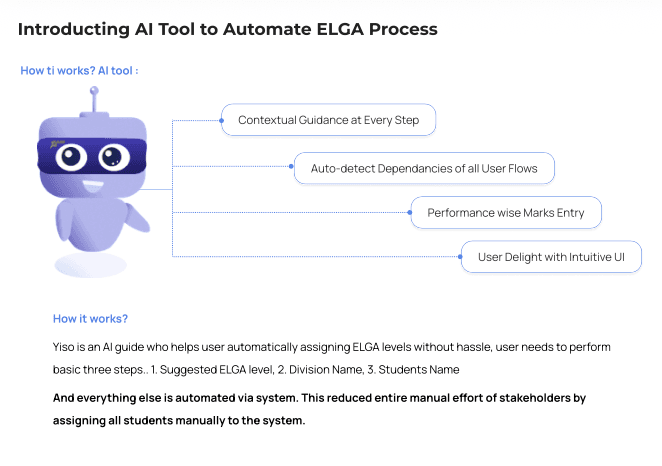
In 2022 I designed an AI recommendation engine called Yiso.
At the time nobody called it AI. The product team called it an "automated recommendation tool." The engineering team called it a "suggestion algorithm." I called it a solution to a research-validated problem — and I designed the entire interaction model for it.
Here's the problem Yiso solved:
ELGA — English Language and General Awareness — was LEAD's flagship academic program and the primary reason schools signed partnership agreements. Getting ELGA right during school onboarding was critical. Getting it wrong meant errors cascading through the entire academic year — wrong student groupings, incorrect curriculum allocation, misaligned resource ordering.
And 70% of LEAD's customer support queries were about ELGA allocation errors.
The existing process required principals to manually understand complex backend dependencies — which class configurations mapped to which ELGA levels, which division structures triggered which student groupings, how individual student marks affected allocation decisions. It was a multi-variable logic problem dressed up as a school admin task.
Look at Image 8 — Subject Teacher Mapping. Every row requiring a selection. Every empty field showing a red error state. Multiply that complexity by ELGA's additional student-level dependencies and you understand exactly why 70% of support tickets came from this one workflow.
Yiso changed the entire interaction model.
Instead of asking principals to understand the system logic, Yiso did the reasoning for them. Three decisions — ELGA level confirmation, division name, student name. Everything else automated. Dependencies detected. Configurations validated. Invalid inputs prevented. Recommended allocation surfaced with clear reasoning.
I designed the full interaction model — the chatbot personality, the contextual guidance at every step, the auto-detection logic interface, the multichannel data entry options, the 6+ use case states for different onboarding scenarios. I ran the heuristic evaluation identifying the three critical failures — no error prevention, no real-world mental model matching, no aesthetic clarity — that Yiso was built to fix.
Two years before AI recommendation interfaces became standard product expectations.
The result? The 70% support ticket burden dropped dramatically. Principals who previously couldn't complete ELGA allocation without AEM hand-holding were completing it independently, accurately, and confidently.
"I didn't design an AI feature. I designed away a problem that was costing the business real money and real relationships — and the solution happened to use intelligence.
There's a moment in every designer's career that tells you exactly where you stand in the organization's trust hierarchy.
Mine came at 9pm.
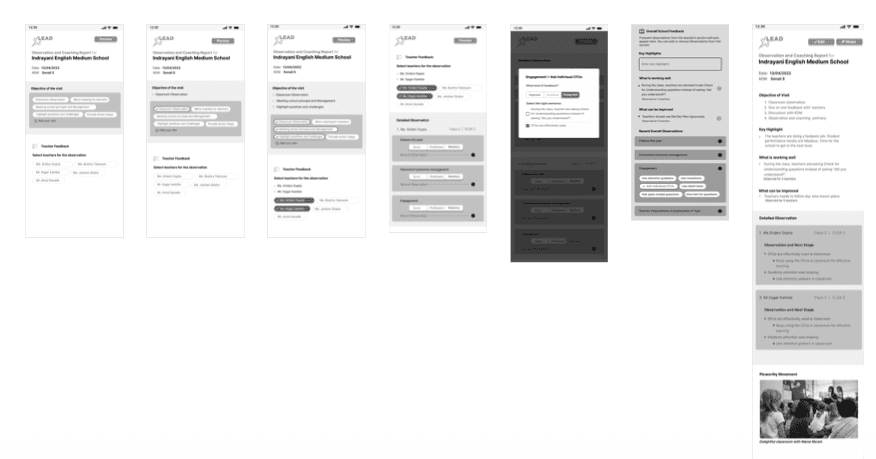
LEAD needed a proof of concept for the OAC Report — a mobile-first observation and coaching report tool for Area Excellence Managers who visited schools and needed to document teacher observations, classroom feedback, and improvement action plans in the field.
Look at Image 4 — Classroom Observation. That clean table with inline editing, rating guidance, training day scores, and the Add CO button — that's the desktop version of what I was solving for mobile. AEMs visiting schools needed the same capability in their hands, not on a desk.
The existing process used Google Docs and PDFs. 3-4 hours per report. AEMs were burning out. Turnover was high.
The stakeholder meeting was in 48 hours. They needed a validated POC. And they chose me.
Not because I was available. Because I was trusted.
I was the most experienced designer on the team — the one who had led research across four products, built Yiso from scratch, and consistently delivered work that balanced UX rigor with production speed. The new designer who had joined to support my workload was good. But this moment needed someone seasoned.
In 48 hours I delivered a complete mobile-first interaction model — report creation, teacher observation documentation, overall school feedback, picworthy moment capture, progressive disclosure for field use, auto-selection logic, draft state management, and a new design system component library aligned with LEAD's marketing guidelines.
The stakeholder meeting happened. The POC was validated. The project was greenlit.
The full module was eventually completed by another designer building on my foundation — but the proof of concept that made the business decision possible came from those 48 hours.
Task completion time when it shipped: 10 minutes. Down from 3-4 hours. 96% reduction.
The team won the Best Group Award. I was part of that team.
Speed without quality is just chaos. Quality without speed is just theory. The 48-hour POC was both — and that's why they called me.
The Numbers That Changed the Business
The outcomes from two years at LEAD weren't isolated metrics. They were interconnected proof points that a design-first approach to enterprise EdTech actually moved business needles.
The ELGA / Yiso Impact: 70% of customer support queries were ELGA-related before Yiso. That dependency dropped dramatically after launch — freeing the customer success team to focus on relationship-building instead of error-correction, and allowing LEAD to onboard more schools without proportional support staffing increases.
The Onboarding Impact: 40+ interviews revealed principals were abandoning onboarding tasks and delegating them entirely to AEMs because the platform felt unusable. The redesigned onboarding flow — built on BJ Fogg's behavioral model with progressive prompts and clear task sequencing — reversed that pattern. Principals started completing onboarding independently. AEM dependency dropped significantly.
The OAC Report Impact: 96% task time reduction. 3-4 hours became 10 minutes. For AEMs visiting multiple schools per week, this wasn't a convenience improvement — it was a burnout prevention intervention. High turnover roles became more sustainable.
The Platform-Wide Impact: 35% reduction in average task completion time across the ERP platform. 22% improvement in educator retention — the highest retention impact recorded at the company. 50% reduction in design-related engineering queries — a direct result of the research documentation, design system discipline, and clear handoff standards I established.
The Gamification Detail Nobody Expected:
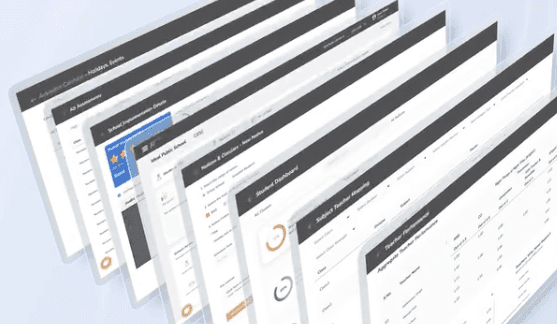
Look at Image 3 and Image 5 — the "You have achieved 3/3 STAR implementation" card on the principal dashboard. That celebratory moment — the stars, the confetti, the affirmation that a school is doing excellent work — exists in a B2B enterprise ERP.
Enterprise products almost never have those moments. They're utilitarian by default. Adding a delight moment to a school management platform was a deliberate design decision — because principals who feel recognized stay engaged. And principals who stay engaged keep their schools in the LEAD ecosystem.
That's not a feature. That's retention design.
The best design impact isn't always visible in the product. Sometimes it's visible in the organization that built it — and the schools that stayed.
What I Built Is Still Running
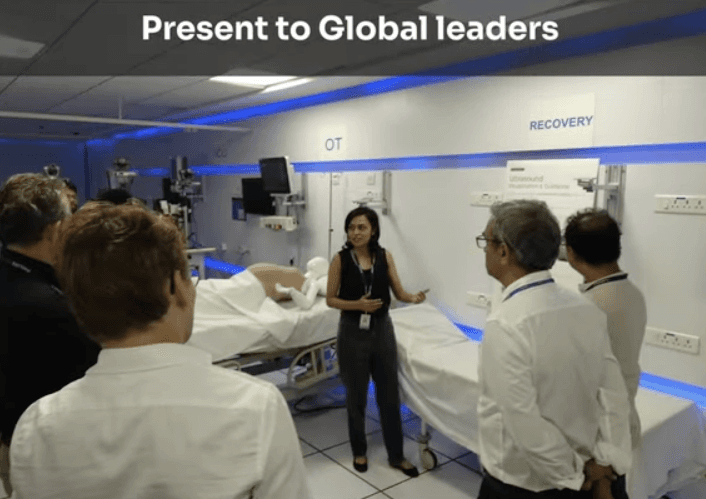
Most case studies end with metrics. Mine ends with something better — evidence.
Every screenshot in this case study isn't a mockup or a prototype. It's a live production interface that principals, coordinators, and school owners are using right now to run their schools across India.
Image 1 — A real principal at a real school, using the Nucleus dashboard at her desk. That's the product I designed.
Image 5 — Nucleus positioned publicly as "India's Most Comprehensive Academic Monitoring System. Your one-stop School Management Platform." That's the product I owned as a solo designer.
Image 6 — Teacher Performance Monitoring with aggregate RT@RT scores, classroom observation data, and the "Teachers Doing Well vs Teachers Needing Support" split. That's the decision-support philosophy I established through research — data that tells you what to do, not just what happened.
Image 7 — Student Dashboard with benchmark visualization, attendance tracking, and practice test completion. That's the information architecture I designed to make complex academic data legible for non-technical school administrators.
Image 9 — Academic Calendar management — clean, filtered, paginated, error-prevented. That's the design system discipline I maintained across every module I touched.
This isn't a portfolio project. This is a national-scale enterprise product that I designed as a solo designer, that outlasted my tenure, that has been iterated on and expanded by teams who built on the foundations I established.
The measure of a designer isn't what they shipped. It's what kept running after they left.
What Design Leadership Without the Title Looks Like
I never had a design lead title at LEAD. I was a Product Designer — singular, individual contributor, no direct reports.
But here's what I actually did:
I ran the research program for an entire design organization. I mentored junior designers on UX methodology, interaction design principles, and how to present work to stakeholders. I set the quality standard the team measured itself against. I was trusted with the most urgent, highest-stakes deliverable when the organization needed it most. When my workload became too heavy they hired another designer — not to replace me, but to support me.
That's leadership. It just didn't have a title attached to it.
What I learned:
Leadership isn't granted by a job description. It's earned by consistently doing more than your role requires — showing up for other designers' problems, raising the research bar across the whole team, and being the person others trust when the deadline is real and the stakes are high.
What I'd do differently:
I'd formalize the mentorship earlier. The design quality improvements I drove through informal guidance and modeling could have been accelerated with structured design critiques, documented research frameworks, and explicit quality standards. The impact was real but it was also dependent on proximity.
What this project proves:
That I can own a complex B2B enterprise product end to end. That I can lead research at organizational scale. That I can build AI-powered interaction models before AI was an expectation. That I can deliver under extreme time pressure without sacrificing quality. That I can make the people around me better designers.
And that the things I build keep running long after I've moved on.
Those aren't just product design skills. Those are the skills of someone who's ready to lead.
They didn't give me the title. They gave me the trust. In the end, that's what leadership actually is.